|

|
Europe
GENTAUR
 +32
1658 9045 +32
1658 9045
+32
1641 4407
 +32
1650 9045 +32
1650 9045
[email protected]
Av. de l' Armée 68
B-1040 Brussels
BELGIUM

France
tel 01 43 25 01 50
fax01 43 25 01 60
9, rue Lagrange
75005 Paris
Italia
tel 02 36 00 65 93
fax 02 36 00 65 94
20135 Milano
Deutschland
tel +32
1658 9045
fax +32
1650 9045
Polska
Tel 00 48 51 760 77
08
Fax 00 32 16 50 90
45
Ulica Ogarna 15/19
B m2
80-826 Gdansk
日本
tel +81 78 386 0860
fax +81 78 306 0296
Minaatojimaminami-manchi
Chuo-ku, Kobe
065-0047

Other
Countries
Österreich
+43720880899
Canada Montreal
+15149077481
Česká republika
Praha
+420246019719
Danmark
+4569918806
Finland Helsset
+358942419041
Ελλάς Αθήνα
+302111768494
Magyarország
Budapest
+3619980547
Ireland Dublin
+35316526556
Luxembourg
+35220880274
Nederland
+31208080893
Norge Oslo
+4721031366
Polska Warszawa
+48223988221
Sverige Stockholm
+46852503438
Schweiz Züri
+41435006251
US New York
+17185132983
|

| |
 |
Product: RayBio® Biotin Label-based
Antibody Arrays |
|
|
| For the Simultaneous Detection of
the Expression Levels of 507 human or 308 Mouse Proteins
in Cell Culture Supernates and Serum |
|
|
|
| Recent technological advances by
Raybiotech have enabled the largest commercially
available antibody array to date. With the L Series
Antibody Array, researchers can now obtain a broad,
panoramic view of cytokine expression. The expression
levels of 507 human or 308 mouse target proteins can be
simultaneously detected, including cytokines, chemokines,
adipokine, growth factors, angiogenic factors, proteases,
soluble receptors, sobuble adhesion molecules , and
other proteins in cell culture supernate or serum.
Furthermore, an internal control is used to monitor the
whole process including biotin-labeling, so this massive
array will accurately reflect the available cytokines in
your sample. Currently, we have developed a new L-series
antibody array for specifically detecting 182 adipokine
proteins in a single array. |
|
|
|
|
|
Mutiple Target proteins on a single array ! |
|
|
Ultra high
detection sensitivity |
|
|
Direct
biotin labeling of proteins |
|
|
Utilizes
either fluorescence or chemiluminescence |
|
|
Accurate
and reproducible |
|
|
Affordable,
quick and simple to use |
|
|
|
|
| Through a simple
process, your sample is biotinylated and then dialyzed
in preparation for incubation with the array. The
process is easy to understand and involves biotinylating
the primary amine of the proteins in the sample. From
here, the newly biotinylated sample is added onto the
antibody arrays either membrane or glass slide and
incubated at room temperature. After incubation with HRP-streptavidin
or Fluorescent dye-Streptavidin, the signals can be
visualized either by chemiluminescence or fluorescence |
|
|
|
| |
| |
| HRP-streptavidin
or Fluorescent dye-Streptavidin |
| |
| Biotinylated
sample |
| |
| Capture
antibody |
| |
|
 Back to top
 |
|
|
|
|
|
|
Dialysis Material |
|
|
Labeling
Reagent |
|
|
Internal
control |
|
|
Stop
Solution |
|
|
RayBio®
Biotin label-based human antibody array I Glass
Chip with Frame Blocking Buffer |
|
|
20X Wash
Buffer I |
|
|
20X Wash
Buffer II |
|
|
Fluorescent
dye-Conjugated Streptavidin
|
|
|
Adhesive
film |
|
|
Serum
Buffer
|
|
|
| The cell culture
supernates or serum is dialyzed before biotin-labeling
step. Through a simple process, the primary
amine of the proteins in the sample is
biotinylated, followed by dialysis to remove
free biotin. From here, the newly biotinylated
sample is added onto the array membrane or glass
slide and incubated at room temperature. After
incubation with HRP-streptavidin or Fluorescent
Dye-Strepavidin, the signals can be visualized
either by chemiluminescence or fluorescence. In
this array, we use an internal control to
monitoring the whole process including biotin-label
and antibody array, it will more exactly respect
the levels in your sample. The experimental
procedure is simple and can be performed in any
laboratory. |
|
|
|
|
Cat# |
Description |
Size |
Detection System |
Species |
Sample type |
Price |
AAH-BLG-ADI-1-2
 |
RayBio® Biotin Label-based
Human Adipokine Antibody Array 1 (Detect
182 human adipokine proteins) |
1 Glass Chip with 2
Subarrays for 2 Samples |
Fluorescence (Cy3 channel) |
Human |
Cell Culture Supernates
and Serum |
498.00€ |
|
AAH-BLG-ADI-1-4
|
RayBio® Biotin Label-based
Human Adipokine Antibody Array 1 (Detects
182 human adipokine proteins) |
1 Glass Chip with 4
Subarrays for 4 Samples |
Fluorescence (Cy3 channel) |
Human |
Cell Culture Supernates
and Serum |
848.00€ |
|
AAH-BLG-1-2 |
RayBio® Biotin Label-based
Human Antibody Array 1 (Detect 507 human
proteins) |
1 Glass Chip with 2
Subarrays for 2 Samples |
Fluorescence (Cy3 channel) |
Human |
Cell Culture Supernates
and Serum |
680.00€ |
|
AAH-BLG-1-4 |
RayBio® Biotin Label-based
Human Antibody Array 1 (Detect 507 human
proteins) |
2 Glass Chip with 4
Subarrays for 2 Samples |
Fluorescence (Cy3 channel) |
Human |
Cell Culture Supernates
and Serum |
1,156.00€ |
|
AAH-BLM-1-2 |
RayBio® Biotin Label-based
Human Antibody Array 1 (Detect 507 human
proteins) |
2 membranes for 2 Samples |
Chemiluminescence |
Human |
Cell Culture Supernates |
895€ |
|
AAH-BLM-1-4 |
RayBio® Biotin Label-based
Human Antibody Array 1 (Detect 507 human
proteins) |
4 membranes for 4 Samples |
Chemiluminescence |
Human |
Cell Culture Supernates |
1,580€ |
|
AAM-BLG-1-2 |
RayBio® Biotin Label-based
Mouse Antibody Array 1 (Detect 308 mouse
proteins) |
1 Glass Chip with 2
Subarrays for 2 Samples |
Fluorescence (Cy3 channel) |
Mouse |
Cell Culture Supernates
and Serum |
578.00€ |
|
AAM-BLG-1-4 |
RayBio® Biotin Label-based
Mouse Antibody Array 1 (Detect 308 mouse
proteins) |
2 Glass Chip with 4
Subarrays for 2 Samples |
Fluorescence (Cy3 channel) |
Mouse |
Cell Culture Supernates
and Serum |
983.00€ |
|
AAM-BLM-1-2 |
RayBio® Biotin Label-based
Mouse Antibody Array 1 (Detect 308 mouse
proteins) |
2 array membranes for 2
Samples |
Chemiluminescence |
Mouse |
Cell Culture Supernates |
778€ |
|
AAM-BLM-1-4 |
RayBio® Biotin Label-based
Mouse Antibody Array 1 (Detect 308 mouse
proteins) |
4 array membranes for 4
Samples |
Chemiluminescence |
Mouse |
Cell Culture Supernates |
1,368€ |
|
AAR-BLG-1-4 |
RayBio® Biotin Label-based
Rat Antibody Array 1 (Detect 90 rat
proteins) |
1 Glass Chip with 4
Subarrays for 4 Samples |
Fluorescence (Cy3 channel) |
Rat |
Cell Culture Supernates
and Serum |
790.00€ |
|
AAR-BLG-1-8 |
RayBio® Biotin Label-based
Rat Antibody Array 1 (Detect 90 rat
proteins) |
2 Glass Chip with 8
Subarrays for 8 Samples |
Fluorescence (Cy3 channel) |
Rat |
Cell Culture Supernates
and Serum |
1,480.00€ |
|
AAR-BLM-1-2 |
RayBio® Biotin Label-based
Rat Antibody Array 1 (Detect 90 rat
proteins) |
2 array membranes for 2
Samples |
Chemiluminescence |
Rat |
Cell Culture Supernates |
498€ |
|
AAR-BLM-1-4 |
RayBio® Biotin Label-based
Rat Antibody Array 1 (Detect 90 rat
proteins) |
4 array membranes for 4
Samples |
Chemiluminescence |
Rat |
Cell Culture Supernates |
888€ |
|
|
|
|
Cat# |
Description |
Application |
Detection System |
Species |
Price
/ per sample |
|
AAH-BLG-ADI-1-Serv-2 |
measuring
2-3 samples using glass
chip |
Cell
Culture Supernates and
Serum |
Fluorescence (Cy3) |
Human |
498€ |
|
AAH-BLG-ADI-1-Serv-4 |
measuring
4-7 samples using glass
chip |
Cell
Culture Supernates and
Serum |
Fluorescence (Cy3) |
Human |
418€ |
|
AAH-BLG-ADI-1-Serv-8 |
measuring
8-20 samples using glass
chip |
Cell
Culture Supernates and
Serum |
Fluorescence (Cy3) |
Human |
378€ |
|
AAH-BLG-ADI-1-Serv-20 |
measuring
over 20 samples using
glass chip |
Cell
Culture Supernates and
Serum |
Fluorescence (Cy3) |
Human |
328€ |
|
AAH-BLG-Serv-2 |
measuring
2-3 samples using glass
chip |
Cell
Culture Supernates and
Serum |
Fluorescence (Cy3) |
Human |
685€ |
|
AAH-BLG-Serv-4 |
measuring
4-7 samples using glass
chip |
Cell
Culture Supernates and
Serum |
Fluorescence (Cy3) |
Human |
520€ |
|
AAH-BLG-Serv-8 |
measuring
8-20 samples using glass
chip |
Cell
Culture Supernates and
Serum |
Fluorescence (Cy3) |
Human |
480€ |
|
AAH-BLG-Serv-20 |
measuring
over 20 samples using
glass chip |
Cell
Culture Supernates and
Serum |
Fluorescence (Cy3) |
Human |
420€ |
|
AAH-BLM-Serv-2 |
measuring
2-3 samples using
membrane array |
Cell
Culture Supernates |
Chemiluminescence |
Human |
815€ |
|
AAH-BLM-Serv-4 |
measuring
4-7 samples using
membrane array |
Cell
Culture Supernates |
Chemiluminescence |
Human |
695€ |
|
AAH-BLM-Serv-8 |
measuring
8-20 samples using
membrane array |
Cell
Culture Supernates |
Chemiluminescence |
Human |
620€ |
|
AAH-BLM-Serv-20 |
measuring
over 20 samples using
membrane array |
Cell
Culture Supernates |
Chemiluminescence |
Human |
580€ |
|
AAM-BLG-Serv-2 |
measuring
2-3 samples using glass
chip |
Cell
Culture Supernates and
Serum |
Fluorescence (Cy3) |
Mouse |
582€ |
|
AAM-BLG-Serv-4 |
measuring
4-7 samples using glass
chip |
Cell
Culture Supernates and
Serum |
Fluorescence (Cy3) |
Mouse |
442€ |
|
AAM-BLG-Serv-8 |
measuring
8-20 samples using glass
chip |
Cell
Culture Supernates and
Serum |
Fluorescence (Cy3) |
Mouse |
408€ |
|
AAM-BLG-Serv-20 |
measuring
over 20 samples using
glass chip |
Cell
Culture Supernates and
Serum |
Fluorescence (Cy3) |
Mouse |
357€ |
|
AAM-BLG-Serv-2 |
measuring
2-3 samples using glass
chip |
Cell
Culture Supernates |
Chemiluminescence |
Mouse |
745€ |
|
AAM-BLG-Serv-4 |
measuring
4-7 samples using glass
chip |
Cell
Culture Supernates |
Chemiluminescence |
Mouse |
630€ |
|
AAM-BLG-Serv-8 |
measuring
8-20 samples using glass
chip |
Cell
Culture Supernates |
Chemiluminescence |
Mouse |
560€ |
|
AAM-BLG-Serv-20 |
measuring
over 20 samples using
glass chip |
Cell
Culture Supernates |
Chemiluminescence |
Mouse |
520€ |
|
AAR-BLG-Serv-2 |
measuring
2-3 samples using glass
chip |
Cell
Culture Supernates and
Serum |
Fluorescence (Cy3) |
Rat |
523€ |
|
AAR-BLG-Serv-4 |
measuring
4-7 samples using glass
chip |
Cell
Culture Supernates and
Serum |
Fluorescence (Cy3) |
Rat |
397€ |
|
AAR-BLG-Serv-8 |
measuring
8-20 samples using glass
chip |
Cell
Culture Supernates and
Serum |
Fluorescence (Cy3) |
Rat |
367€ |
|
AAR-BLG-Serv-20 |
measuring
over 20 samples using
glass chip |
Cell
Culture Supernates and
Serum |
Fluorescence (Cy3) |
Rat |
321€ |
|
AAR-BLM-Serv-2 |
measuring
2-3 samples using glass
chip |
Cell
Culture Supernates and
Serum |
Fluorescence (Cy3) |
Rat |
598€ |
|
AAR-BLM-Serv-4 |
measuring
4-7 samples using glass
chip |
Cell
Culture Supernates and
Serum |
Fluorescence (Cy3) |
Rat |
498€ |
|
AAR-BLM-Serv-8 |
measuring
8-20 samples using glass
chip |
Cell
Culture Supernates and
Serum |
Fluorescence (Cy3) |
Rat |
448€ |
|
AAR-BLM-Serv-20 |
measuring
over 20 samples using
glass chip |
Cell
Culture Supernates and
Serum |
Fluorescence (Cy3) |
Rat |
398€ |
|
|
|
 |
Analysis Software |
 |
|
|
AAH-BLG-ADI-1-SW |
Analysis software L
series Human Adipokine
182 (membrane or slide) |
160€ |
|
AAH-BLG-1-SW |
Analysis software L
series Human 507 (slide) |
220€ |
|
AAH-BLM-1-SW |
Analysis software L
series Human 507
(membrane) |
220€ |
|
AAM-BLG-SW |
Analysis software L
series Mouse 308 (slide) |
200€ |
|
AAM-BLM-SW |
Analysis software L
series Mouse 308
(membrane) |
200€ |
|
AAR-BLG-SW |
Analysis software L
series rat (slide) |
180€ |
|
AAR-BLM-SW |
Analysis software L
series rat (membrane) |
180€ |
|
|
|
|
|
Examples of Array |
|
|
| A) Human
L-Series 507 |
|
|
|
The figure shows the RayBio® Biotin-label-based
Human Antibody Array I probed with two
cell culture supernates. The image were
captured using a Axon GenePix laser
scanner.
|
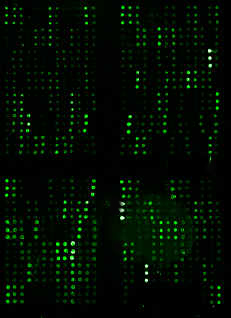
| B) Mouse
L-Series 308 |
|
|
| The figure shows
the RayBio® Biotin-label-based Mouse
Array 1 probed with Mouse sample. The
image were captured using a Axon GenePix
laser scanner.
|
|
|
|
|
| 1. Profiling of
cytokine expression by biotin-labeled-based
proteinarrays. Ying Lin, Ruochun
Huang, Lipai Chen et al. Proteomics.2003,
3: 1750-1757. |
| 2. Proteomic
profiling of the cancer
microenvironment by antibody arrays.
Vladimir Knezevic, Chidchanok
Leethanakul, Verena E. Bichsel et
al. Proteomics 2001, 1, 1271–1278 |
| 3. Antibody
microarray profiling of human
prostate cancer sera: Antibody
screening and identification of
potential biomarkersJeremy C.
Miller, Heping Zhou, Joshua Kwekel,
Robert Cavalloet al. The, Brian B.
Haab. Proteomics. 2003, 3: 56-63. |
| 4. Smad4
signalling in T cells is required
for suppression of gastrointestinal
cancer. Byung-Gyu Kim, Cuiling Li,
WenhuiQiao, Mizuko Mamura, Barbara
Kasperczak, Miriam Anver, Lawrence
Wolfraim, Suntaek Hong, Elizabeth
Mushinski, Michael Potter, Seong-Jin
Kim, Xin-Yuan Fu, Chuxia Deng
and John J. Letterio. Nature. 2006;
Vol 441: 1015 |
| 5. Connexin
suppresses human glioblastoma cell
growth by down-regulation of
monocyte chemotactic protein 1, as
discoveredusing protein array
technology. Ruochun Huang, Ying Lin,
Cheng C. Wang, Jacob Gano, Biaoyang
Lin, Qian Shi, AltonBoynton, Jocelyn
Burke, and Ruo-Pan Huang. Cancer Res.
2002;62:2806-2812. |
| 6. LPS induces
the interaction of a transcription
factor, LPS-induced TNF-a factor,
and STAT6(B) with effects on
multiple cytokines.Xiaoren Tang,
Deborah Levy Marciano, Susan E.
Leeman and Salomon Amar. PNAS. April
5, 2005 vol. 102 no. 14, 5132-5137
|
| 7.
HIV-1-mediated apoptosis of neuronal
cells: Proximal molecular mechanisms
of HIV-1-induced encephalopathy. Yan
Xu, JosephKulkoshy, Roger j.
Pomerantz. PNAS. 2004 May 4, 2004
Vol. 101 No. 18. |
| 8. A novel
method for high-throughput protein
profiling fromconditioned media and
patient’s sera. Ruo-Pan Huang,
RuochunHuang, Yan Fan, and Ying Lin.
Ana. Biochem. 2001;294(1):55-62. |
|
|
|
|
|